If you slice a circle from the center into 360 equal wedges, each wedge measures exactly one degree. But why 360 and not some other number?
A degree is the smallest unit of angle measurement when you divide a full circle into 360 equal parts. Here is what one degree looks like:

At 90 degrees — a quarter of the circle — you get a right angle. At 180 degrees — half the circle — you get a straight angle.
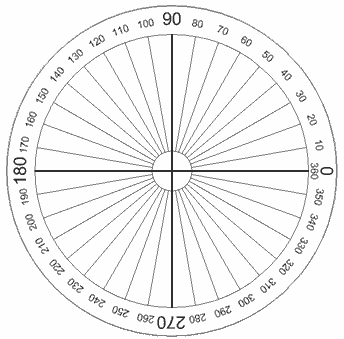
The number 360 is generally credited to the Babylonians, who developed a number system based on 60. They were probably the first to divide the circle into 360 degrees (6 × 60).
There are two theories about why they chose 60. The first says it was an approximation of the number of days in a calendar year. The second says the Babylonians chose it because 60 is divisible by many numbers: 1, 2, 3, 4, 5, 6, 10, 12, 15, 18, 20, 24, 30, 36, 45, and 60.
Because of how close 360 is to 365 (days in a year), the calendar theory is the most widely accepted: using 360 degrees let ancient astronomers roughly match each day of the year to one degree of the Sun's movement around the Earth.
Click on any element to learn more.