At Saturn's north pole sits one of the strangest atmospheric structures in the solar system: a persistent storm shaped like a perfect hexagon.
This hexagonal cloud storm is a jet stream with turbulent, unstable weather. It raises big questions for scientists: is Saturn just a giant ball of gas?
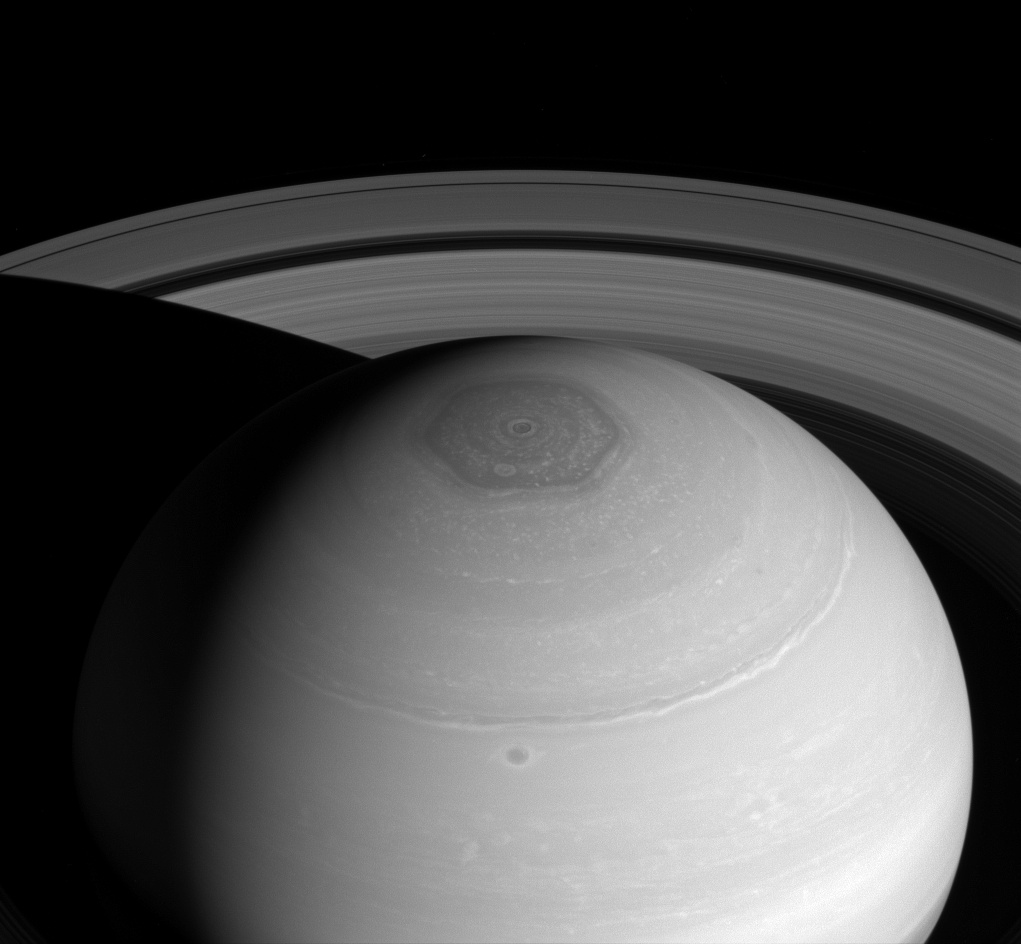
Image taken by NASA. By NASA/JPL-Caltech/Space Science Institute [Public domain], via Wikimedia Commons
Size: about 13,800 km across — the entire Earth (diameter 12,700 km) would fit inside it.
Duration: it has been active for decades since its discovery, and possibly centuries before that.
Discovery: spotted in the early 1980s by NASA's Voyager 1 and 2 probes.
First video: in 2009 the Cassini mission captured a video of the storm in motion.
On Earth, a storm only lasts a few days. Mountains and solid structures break storms apart and scatter them. So if Saturn's storm never dissolves, does that mean there are no solid structures like mountains? Is Saturn really just a gas giant?
The Cassini probe photographed the central vortex of the storm using color filters that reveal details of the atmospheric structure invisible to the naked eye.
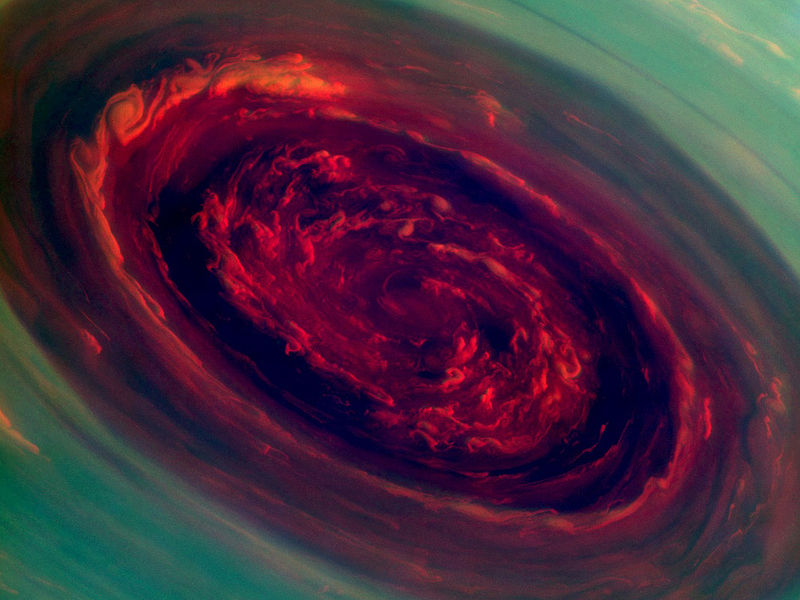
The hexagonal storm vortex in false color.
The animated image below was taken by the Cassini probe on November 10, 2006 and shows the rotation of the hexagonal storm at Saturn's north pole.
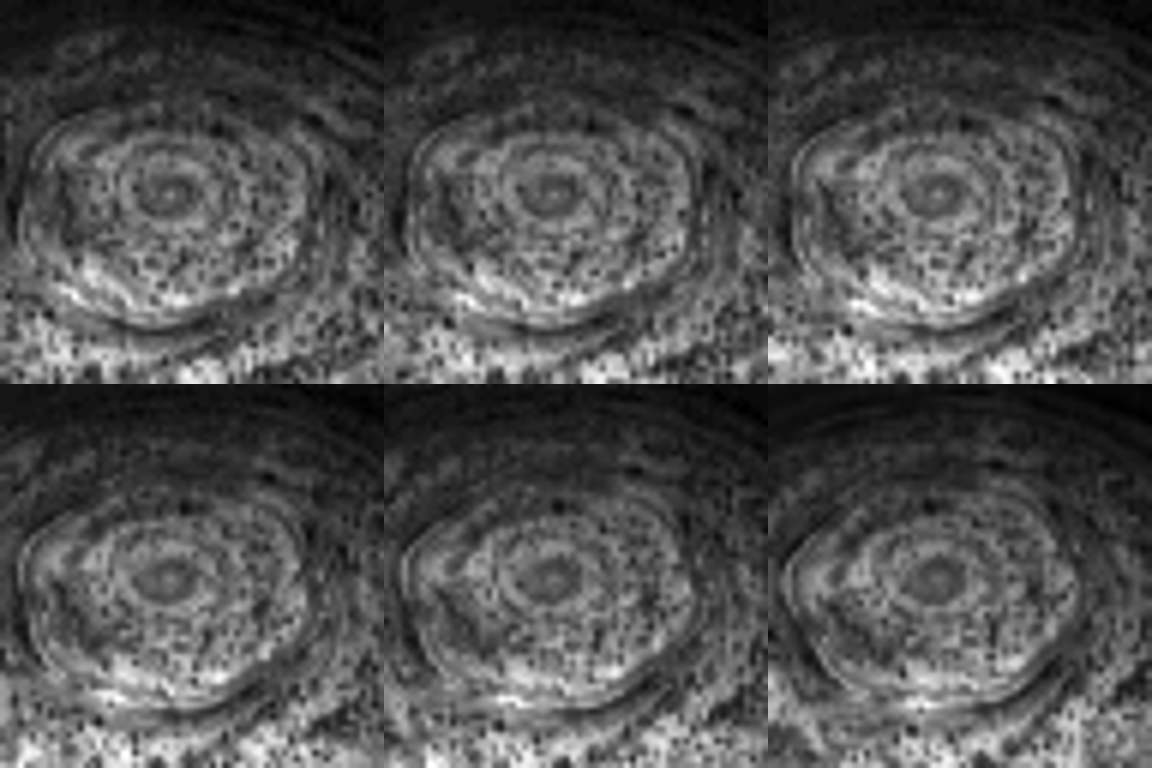
By NASA [Public domain], via Wikimedia Commons
Click on any element to learn more.